
Mobile App
Native vs Hybrid App: Which Should You Build in 2026?
Native apps are built separately for Android (Kotlin/Java) and iOS (Swift) and give the best performance and device access. Hybrid or cross-platform apps (Flutter, React Native) use one codebase for both, cost less and launch faster. For most business apps, hybrid app development is the better choice; choose native for heavy graphics, AR or cutting-edge device features.
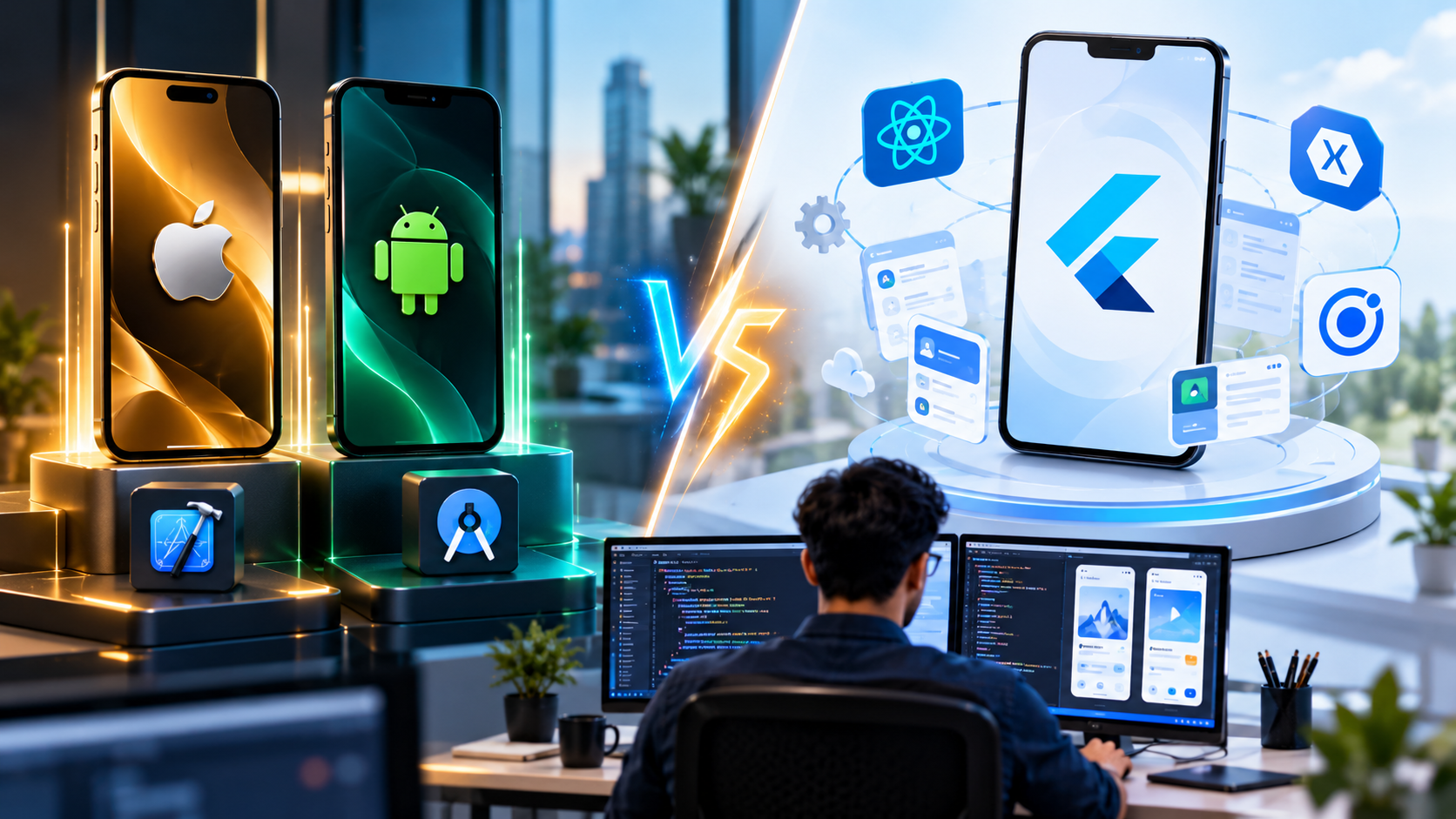
One of the first decisions in any app project is whether to build native apps or use hybrid app development. The choice affects your budget, launch date, app performance and how easy it is to maintain the app for years.
This guide explains both approaches in plain language, compares them side by side, and gives a simple decision framework.
In this guide:
- What native and hybrid apps are
- Flutter vs React Native in brief
- Side-by-side comparison
- When to choose native, when to choose hybrid
- Common myths and FAQs
What Is a Native App?
A native app is built specifically for one platform using its own language and tools:
- Android: Kotlin or Java, with Android Studio
- iOS: Swift, with Xcode
Because it is built for one platform, a native app gets full access to device features and the best possible performance. The trade-off is that you build and maintain two separate apps.
What Is a Hybrid (Cross-Platform) App?
A hybrid or cross-platform app is written once and runs on both Android and iOS. Modern frameworks compile to near-native performance for most use cases.
Flutter
Google's framework using the Dart language. It draws its own UI, so apps look consistent on every device. Popular for business, e-commerce and fintech apps.
React Native
Meta's framework using JavaScript/TypeScript and native UI components. A good fit for teams already working in JavaScript.
Native vs Hybrid: Side-by-Side Comparison
Native | Hybrid (Flutter / React Native) | |
|---|---|---|
Codebases | Two (Android + iOS) | One |
Development cost | Higher | Lower for both platforms |
Time to launch | Longer | Faster |
Performance | Best, especially graphics-heavy apps | Very good for most business apps |
Device features | Full, immediate access | Most features, sometimes via plugins |
UI consistency | Platform-specific look | Same design on both platforms |
Maintenance | Two apps to update | One codebase |
Team needed | Android + iOS developers | One cross-platform team |
Best for | Games, AR, heavy media | E-commerce, booking, fintech, ERP, MLM, delivery |
When to Choose Native
- Your app relies on heavy 3D graphics, AR/VR or complex animations.
- You need new device features on launch day.
- Performance is critical at a very large scale.
- You are building for only one platform anyway.
When to Choose Hybrid
- You need Android and iOS on a limited budget.
- Speed to market matters.
- Your app is mostly forms, lists, payments, maps, chat and dashboards.
- You want one team and one codebase to maintain.
Decision Guide: 5 Questions
- Do you need both Android and iOS? Yes → lean hybrid.
- Does the app use heavy graphics, AR or games? Yes → lean native.
- Is budget tight or launch urgent? Yes → hybrid.
- Do you need very specific device features? Yes → check plugin support or go native.
- Who will maintain the app long term? A small team → hybrid.
Expert tip: ask your developer to build a small proof of concept for any unusual device feature before committing to hybrid. It removes the biggest risk in a day or two.
Common Myths
- "Hybrid apps are slow." Modern Flutter and React Native apps feel native for most business uses.
- "Native is always better." Only if you need what native uniquely offers.
- "Hybrid can't use device features." Most features (camera, GPS, biometrics, notifications) are well supported.
Frequently Asked Questions
Is Flutter better than React Native? Both are strong. Flutter offers consistent UI; React Native suits JavaScript teams.
Will users know my app is hybrid? For most business apps, no.
Is hybrid app development cheaper? Usually yes, when you need both platforms, because there is one codebase.
Can a hybrid app be published on the Play Store and App Store? Yes, just like native apps.
Can I switch from hybrid to native later? Yes, but it means rebuilding, so choose carefully.
Which approach is better for an MLM or e-commerce app? Hybrid is usually the best fit: faster, cheaper and easy to maintain.
Build once, launch on both
Sysfo's hybrid app development team builds Flutter and cross-platform apps, and we also offer Android and iOS native development when your app needs it.