Business
How to Start a Crypto Exchange in India: Features, Cost and Compliance (2026)
India has one of the world's largest crypto user bases, and demand for local, compliant exchanges keeps growing. But starting a crypto exchange is not just about building a trading website. You need the right business model, secure software, liquidity, and, most importantly, compliance with Indian anti-money-laundering rules from day one.
India has one of the world's largest crypto user bases, and demand for local, compliant exchanges keeps growing. But starting a crypto exchange is not just about building a trading website. You need the right business model, secure software, liquidity, and, most importantly, compliance with Indian anti-money-laundering rules from day one.
This guide walks through the exchange models you can choose, the features your platform needs, the compliance requirements in India, and what it costs to launch with white label or custom software.
Choose Your Exchange Model: CEX, DEX or Hybrid
Model | How it works | Pros | Watch out for |
|---|---|---|---|
Centralised exchange (CEX) | The platform holds user funds and matches orders in its own order book | Fast trading, fiat (INR) deposits, familiar experience | You are responsible for custody, security and full KYC/AML compliance |
Decentralised exchange (DEX) | Users trade directly from their own wallets through smart contracts | No custody of user funds, transparent on-chain trades | Harder fiat on-ramp, smart contract risk, regulatory grey areas |
Hybrid exchange | Combines a centralised order book or interface with non-custodial or on-chain settlement | Balance of speed and user control | More complex to build and audit |
Most businesses targeting Indian retail users start with a CEX, because INR deposits and a simple app are what users expect.
Must-Have Features of a Crypto Exchange Platform
[Featured image yahan lagao: crypto-exchange-guide-2026.png]
For traders
- Spot trading with market, limit and stop-limit orders
- Fast matching engine and real-time order book, charts and trade history
- Multi-currency wallets with deposit and withdrawal for major coins and INR
- Simple onboarding with in-app KYC
- Android and iOS apps with price alerts and push notifications
For security
- Hot and cold wallet separation, with most funds in cold storage
- Two-factor authentication, withdrawal whitelists and device/session controls
- Encrypted data, regular security audits and DDoS protection
- Full audit logs of admin and user actions
For the admin team
- KYC review queue, risk flags and suspicious transaction alerts
- Coin and trading pair listing, fee settings and limits
- Liquidity and market-making integration
- Reports for accounting, TDS and regulatory filing
- Support ticket system for user queries
Growth features (phase two)
- P2P trading, staking, futures or margin (only where legally permitted)
- Referral programmes and fee discounts
- API access for algorithmic traders
Compliance Requirements in India (2026)
Since March 2023, virtual digital asset (VDA) businesses in India fall under the Prevention of Money Laundering Act (PMLA). In practice, this means:
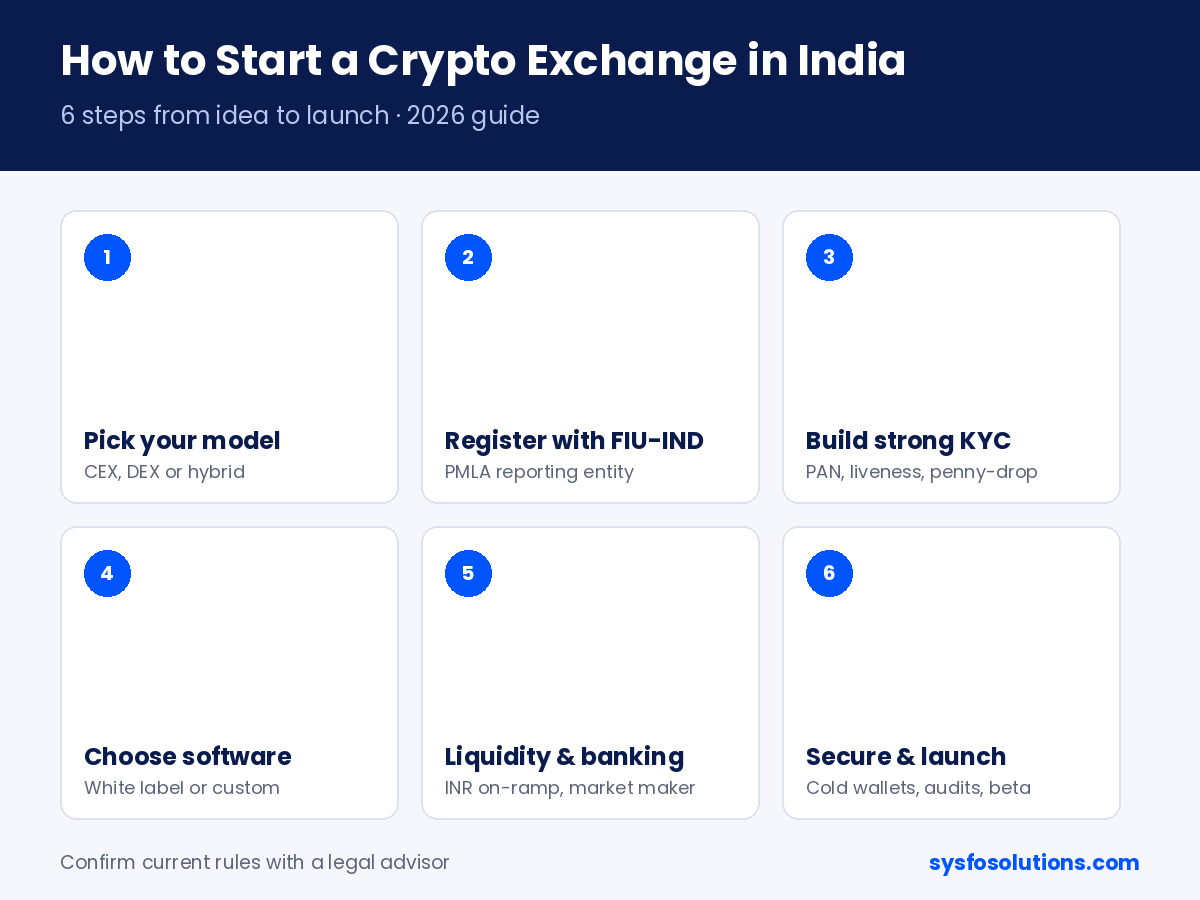
- Register with FIU-IND. Exchanges and wallet providers must register with the Financial Intelligence Unit – India as reporting entities before serving Indian users.
- Strong KYC. Guidelines reported in January 2026 call for PAN plus a second ID, OTP-verified email and mobile, bank account verification through a small "penny-drop" transaction, and a live selfie with liveness checks, along with recording the user's location, timestamp and IP during onboarding.
- Ongoing monitoring. KYC is refreshed periodically (more often for high-risk users), with enhanced checks for links to high-risk jurisdictions and politically exposed persons.
- Record keeping and reporting. Client and transaction records must be kept for five years, and suspicious transactions reported.
- Tax handling. Income from transferring VDAs is taxed at a flat 30%, and 1% TDS applies on specified transactions under Section 194S of the Income Tax Act. Your platform needs to deduct, record and report TDS correctly.
Your exchange software should support these workflows out of the box: KYC with liveness checks, transaction monitoring, audit logs and TDS reports. Rules change often, so confirm current requirements with a legal advisor before launch.
White Label vs Custom Crypto Exchange Software
White label exchange | Custom-built exchange | |
|---|---|---|
What it is | A ready, tested exchange platform rebranded and configured for you | Software designed and coded from scratch for your model |
Time to launch | Weeks | Several months |
Upfront cost | Lower | Much higher |
Flexibility | Configurable features, fees, coins and branding | Anything you can specify |
Risk | Proven code, fewer unknowns | More testing and audits needed |
Best for | Most new exchanges entering the market | Large players with a unique model or very high volume |
Cost depends on the model (CEX, DEX or hybrid), number of coins and trading pairs, mobile apps, liquidity integration, KYC and compliance modules, and security audits. Ask vendors for a fixed, itemised quote, and budget separately for licences, legal advice, liquidity, hosting and ongoing security.
Steps to Launch Your Crypto Exchange
- Choose your market and model. Decide who you serve (Indian retail, traders, a niche token community) and whether you run a CEX, DEX or hybrid.
- Set up the company and compliance. Incorporate, get legal advice, and register with FIU-IND before onboarding Indian users.
- Pick your software. White label for speed, or custom for a unique model. Insist on a live demo and security documentation.
- Arrange banking and liquidity. Payment partners for INR deposits and a liquidity provider or market maker so the order book isn't empty on day one.
- Secure the platform. Cold storage setup, penetration testing, and smart contract audits for any on-chain components.
- Test with a closed beta. Invite a small group, test deposits, trades, withdrawals, KYC and TDS reports end to end.
- Launch and grow. Go live with support ready, then add features like P2P or staking in later phases.
Frequently Asked Questions
Is it legal to start a crypto exchange in India? Crypto trading is not banned in India, but exchanges serving Indian users must register with FIU-IND under the PMLA and follow KYC, AML and tax rules. Get legal advice for your specific model before launch.
How long does it take to launch a crypto exchange? With white label software, the technical setup can take a few weeks. The full launch, including company setup, compliance, banking and liquidity, usually takes longer.
What is white label crypto exchange software? It is a ready-made, tested exchange platform that a provider brands and configures for your business, so you avoid building matching engines, wallets and admin panels from scratch.
How is crypto taxed in India? Income from transferring virtual digital assets is taxed at a flat 30%, and 1% TDS applies on specified transactions under Section 194S. Your exchange must deduct and report TDS correctly.
What makes a crypto exchange secure? Cold storage for most funds, two-factor authentication, withdrawal controls, encrypted data, regular penetration tests and audits, and clear audit logs of every admin action.
Launch your exchange with Sysfo
Sysfo's Crypto Exchange Software supports centralised, decentralised and hybrid models, with secure wallets, admin and KYC panels, and mobile apps. Our crypto and blockchain team also builds smart contracts and custom features. Book a free demo to see it configured for your plan.