Business
How to Start an AePS and Money Transfer Business in India
An AePS business lets retail shops offer Aadhaar-based cash withdrawal, balance enquiry, money transfer (DMT) and bill payments (BBPS), earning a commission on each transaction. To start, choose a role (retailer, distributor or portal owner), partner with an authorised service provider, use fintech software with wallets and commissions, and onboard trained retailers with certified biometric devices.
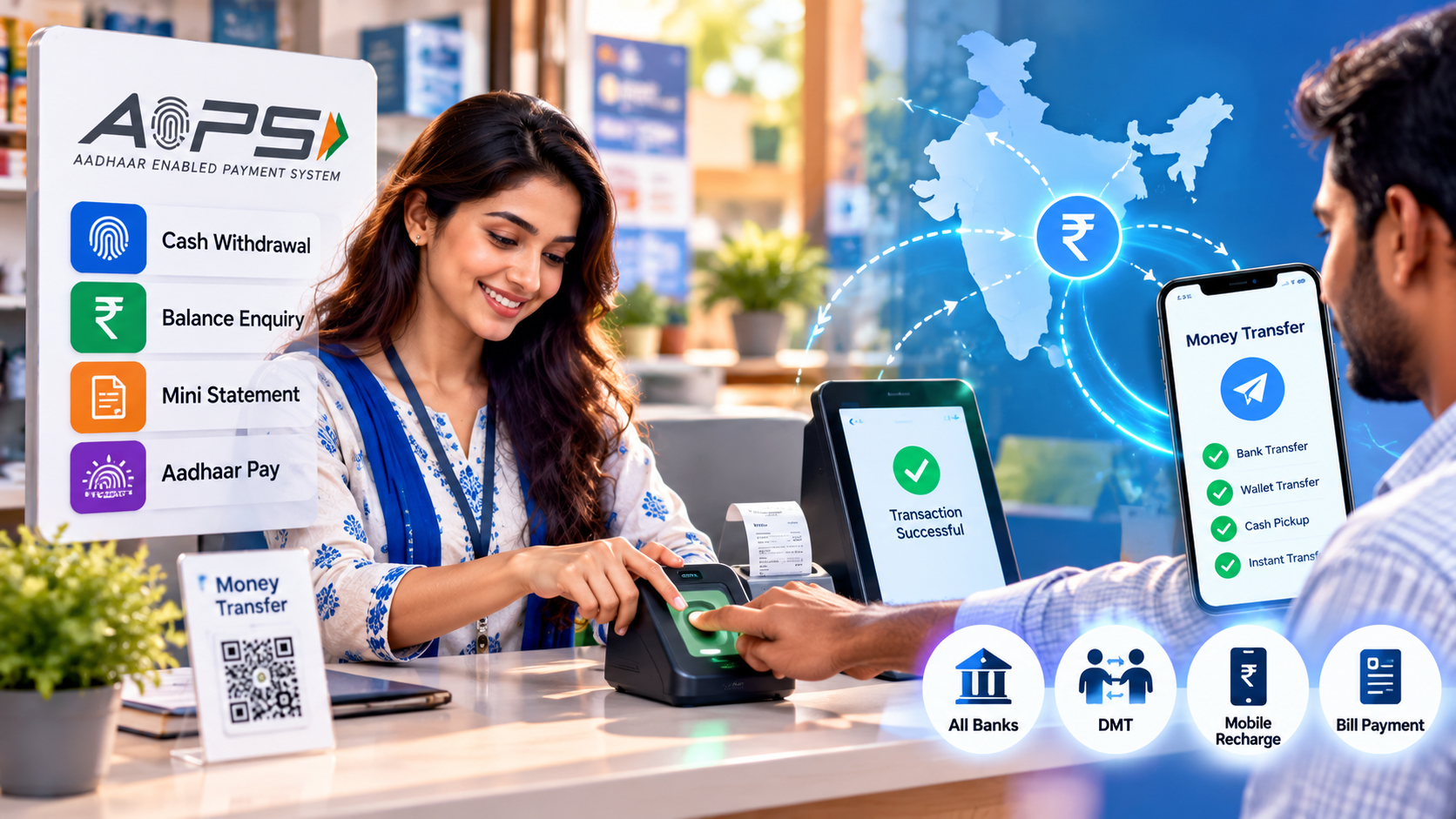
For millions of people in rural and semi-urban India, the nearest bank branch or ATM can be far away. The local kirana, mobile or photocopy shop often becomes their bank: withdrawing cash with Aadhaar, sending money to family and paying bills. An AePS business turns these everyday needs into steady commission income for retailers, distributors and portal owners.
For a plain-English explainer of the services, read our guide to AePS, DMT and BBPS.
This article is general information. Fintech services are regulated; confirm requirements with your service partner and advisors.
In this guide:
- Services you can offer
- How the AePS business works
- Business models and roles
- Must-have fintech software features
- Steps to start, compliance and FAQs
Services You Can Offer
Service | What customers can do |
|---|---|
AePS (Aadhaar Enabled Payment System) | Cash withdrawal, balance enquiry and mini statement using Aadhaar and fingerprint |
DMT (Domestic Money Transfer) | Send money to any bank account across India |
BBPS (Bharat Bill Payment System) | Pay electricity, water, gas, broadband, loan EMIs and more |
Mobile & DTH recharge | Prepaid recharges and top-ups |
Micro ATM (optional) | Card-based cash withdrawal |
Other services (optional) | Insurance, PAN services, travel bookings via partners |
How the AePS Business Works
- Licensed banks or authorised partners provide AePS, DMT and BBPS services through APIs.
- Your fintech platform connects to these APIs and gives retailers an app or portal.
- Retailers use a smartphone or computer and a certified biometric device to serve customers.
- Settlement: cash withdrawn by a customer is credited to the retailer's wallet or bank, since the retailer pays out cash from the counter.
- Commissions are shared between the portal owner, distributors and retailers.
Business Models and Roles
Role | What you do | Who it suits |
|---|---|---|
Retailer / CSP point | Serve walk-in customers at your shop | Shop owners in towns and villages |
Distributor | Onboard, train and support retailers | People with local networks |
Master distributor | Manage distributors in a region | Experienced operators |
Portal owner (B2B) | Run your own branded fintech platform | Entrepreneurs building a network |
Must-Have Fintech Software Features
Onboarding and compliance
- Retailer onboarding with KYC and document verification
- Role-based hierarchy: admin, master distributor, distributor, retailer
Services
- AePS with certified biometric device support
- DMT with beneficiary management and transaction limits
- BBPS bill fetch and payment
- Recharge and optional micro ATM
Money management
- Wallets, settlement to bank and fund requests
- Commission and charges by service and level
Control and safety
- Real-time transaction status, refunds and dispute tracking
- Fraud checks, velocity limits and audit logs
- Reports for transactions, commissions and settlements
Apps
- Android app and web portal with white-label branding
Steps to Start an AePS Business
- Choose your role: retailer, distributor or portal owner.
- Register your business and open a current account.
- Select an authorised service partner for AePS, DMT and BBPS, and complete their onboarding.
- Launch white-label fintech software with your brand.
- Set commissions and charges for each level and service.
- Onboard retailers with KYC and certified biometric devices.
- Train retailers on customer verification, fraud awareness and cash handling.
- Monitor transactions and support your network.
Expert tip: your success depends on transaction success rates and fast settlements. Choose partners and software that handle failures and refunds quickly, because one bad experience can lose a retailer.
Compliance and Safety Essentials
- Work only with authorised banks or service partners.
- Complete KYC for every retailer.
- Use certified biometric devices only.
- Follow transaction limits and reporting rules set by your partner.
- Train retailers to protect customers' Aadhaar and fingerprint data.
Common Mistakes
- Choosing a partner with poor success rates or slow settlements.
- Weak retailer KYC, which invites fraud.
- No retailer training or support.
- Unclear commission structures.
- Ignoring refunds for failed transactions.
Frequently Asked Questions
Do I need RBI approval to run an AePS portal? Services are usually offered through licensed banks or authorised partners. Requirements depend on your model; confirm with your partner and a legal advisor.
What equipment does a retailer need? A smartphone or computer, internet connection and a certified biometric fingerprint device.
How do retailers earn from AePS? They earn a commission on eligible transactions such as cash withdrawals, money transfers and bill payments, as set by the platform.
Is AePS safe for customers? Yes, when done through authorised partners, certified devices and trained retailers.
Can I add recharge and bill payments too? Yes. Most fintech portals combine AePS, DMT, BBPS and recharge.
What is the difference between AePS and micro ATM? AePS uses Aadhaar and fingerprint; micro ATM uses a debit card and PIN.
Launch your fintech portal with Sysfo
Sysfo's Fintech Software brings AePS, DMT and BBPS together for distributor and retailer networks, with wallets, commissions, reports and apps under your brand. Add recharges with RechargeNest.