E-Commerce
How to Choose the Best Payment Gateway for Ecommerce in India
UPI, cards, COD, settlement and KYC: a practical guide to comparing Indian payment gateways and integrating the right one into your online store.

Your payment page is the last step between a shopper and a sale, and a failed or confusing payment is a lost order. Choosing a payment gateway for ecommerce in India is not just about picking a well-known name. You need the right payment methods for your customers, a smooth checkout on mobile, predictable settlement into your bank account, and an integration that works with your store platform. This guide explains what to look for, compares the gateways Indian businesses use most, and gives you a checklist for going live.
What a payment gateway actually does
A payment gateway securely collects payment details from your customer, sends them to the bank or UPI network for authorisation, and tells your store whether the payment succeeded. Most Indian gateways operate as payment aggregators: they collect money on your behalf and settle it to your current account after deducting their charges. The Reserve Bank of India regulates payment aggregators, which is one reason onboarding involves KYC checks and why gateways ask to see your website policies.
Because RBI's card tokenisation rules stop merchants storing customers' full card numbers, saved-card features now work through network tokens managed by the gateway and card networks. Never build your own card storage.
Payment methods your Indian customers expect
UPI
UPI, run by NPCI, is the most used digital payment method in India. Your gateway should support UPI intent (opening the customer's UPI app directly on mobile), UPI QR codes on desktop, and ideally UPI AutoPay for subscriptions. Intent flows are usually faster and complete more often than asking the customer to type a UPI ID and approve a collect request.
Cards, net banking, wallets and EMI
Credit and debit cards on Visa, Mastercard, RuPay and often Amex and Diners, net banking with all major banks, popular wallets, and EMI options (card EMI, cardless EMI and pay later) all matter for higher-value orders. Check which banks and EMI providers each gateway actually supports, not just the headline count.
Cash on delivery
COD is still important in many Indian categories and smaller towns. A payment gateway does not process COD itself; the cash is collected by your courier and remitted to you. What you need is a store that lets you switch COD on or off, set a maximum COD order value, and offer prepaid incentives. Some gateways also provide payment links you can send to convert COD orders to prepaid before dispatch, which reduces returns and cash handling.
Comparing popular payment gateways in India
All the gateways below are established and widely used. Their features and pricing change often, so treat this as a starting point and confirm current details with each provider. We have deliberately left out fees: ask each gateway for a written quote for your expected volume and payment mix.
- Razorpay: a developer-friendly platform with a broad range of payment methods, a well-documented API, plugins for common store platforms, payment links, subscriptions and split settlements for marketplaces. A common choice for startups and growing D2C brands.
- PayU: one of the longest-established gateways in India, with wide bank and EMI coverage and plugins for popular platforms. Often chosen by established retailers and businesses that want strong EMI and affordability options.
- Cashfree Payments: known for payouts and fast settlement options alongside payment collection, plus split payments for marketplaces. Useful when you also need to pay vendors, sellers or refunds in bulk.
- CCAvenue: a long-running gateway with a very wide choice of payment options and multi-currency support, which suits businesses that sell to overseas customers as well as Indian buyers.
- PhonePe Payment Gateway: built around UPI, with the advantage of a payment app that many Indian shoppers already use, plus cards and net banking. A good fit where most of your customers pay by UPI.
- Stripe: a global platform with excellent developer tools and international card acceptance. Its availability for Indian businesses has changed in recent years, so check whether it is onboarding businesses like yours before you plan around it.
How to choose the right payment gateway for ecommerce
Rather than asking which gateway is "best", ask which one fits your business. Score each option against these points:
- Payment mix: what share of your customers pay by UPI, cards, EMI or wallets, and does the gateway cover them well?
- Success rate: ask for typical success rates for your category and payment methods, and test the checkout yourself on a mid-range Android phone.
- Settlement: how many working days until money reaches your account, and is faster settlement available if you need it?
- Refunds and disputes: how easy is it to issue full or partial refunds, and how are chargebacks handled?
- Business model fit: marketplaces need split payments and vendor payouts; subscription businesses need recurring payments; exporters need international cards and currencies.
- Integration: are there ready plugins for your platform, and are the APIs, webhooks and test environment well documented?
- Support and dashboard: can your team see transactions, settlements and reports clearly, and is support responsive when payments fail?
Settlement, KYC and documentation
Settlement is the time between a customer paying and the money reaching your bank account. Standard settlement is commonly a day or two after the transaction on working days, and some gateways offer faster or instant settlement as an add-on.
KYC requirements vary by business type, but you should expect to provide:
- PAN of the business and of the authorised signatory.
- Business registration proof, such as a partnership deed, certificate of incorporation or Udyam registration.
- GST certificate, where applicable to your business.
- A cancelled cheque or bank statement for the settlement account.
- A live website or app with clear product pricing and contact details.
- Published policies: terms and conditions, privacy policy, refund and cancellation policy, and shipping policy.
Missing policies are a frequent reason for onboarding delays, so publish them before you apply. Some product categories need additional approval or may not be supported at all; check this early. For specific compliance questions, speak to your chartered accountant or legal adviser.
Integration checklist before you go live
- Create accounts and complete KYC with your chosen gateway, and get test API keys.
- Integrate checkout using the gateway's official plugin or SDK, never by handling raw card data yourself.
- Verify every payment on your server using the gateway's signature or status API, not just the browser redirect.
- Set up webhooks so orders are updated even if the customer closes the browser before returning to your site.
- Handle every outcome: success, failure, pending and user-cancelled, with clear messages and a retry option.
- Test refunds, partial refunds and duplicate-payment cases in the test environment.
- Show the transaction ID on the order confirmation and the invoice.
- Switch to live keys, run a few small real payments, and confirm they settle correctly to your bank account.
- Keep API keys in server configuration, never in mobile app code or front-end scripts.
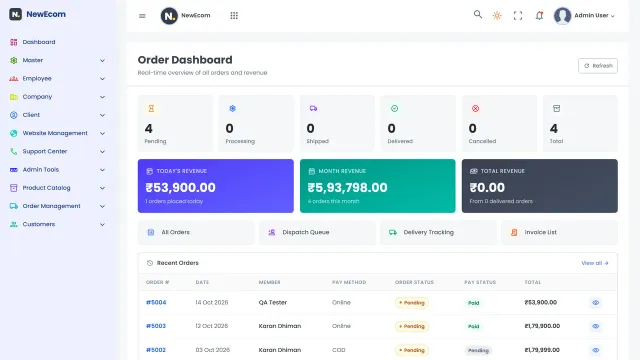
If you are building a new store, our e-commerce website development team handles gateway integration as part of the project. Our ready e-commerce software supports UPI, QR, cards and net banking through Razorpay, PayU or your bank's gateway, with cash on delivery controlled by a switch and an order-value limit. For marketplaces, see our multi-vendor e-commerce software.
Frequently asked questions
Which is the best payment gateway for an e-commerce website in India?
There is no single best gateway for every store. Razorpay, PayU, Cashfree, CCAvenue and PhonePe PG are all widely used. The right choice depends on your payment mix, settlement needs, business model such as marketplace or subscriptions, and how well the gateway integrates with your platform. Compare a written quote and test the checkout before deciding.
What documents are needed for a payment gateway in India?
Typically the business PAN, the authorised signatory's PAN and ID, business registration proof, a GST certificate where applicable, and bank account proof such as a cancelled cheque. Gateways also review your website or app, so publish terms and conditions, privacy, refund and cancellation, and shipping policies, along with clear pricing and contact details, before you apply.
Does a payment gateway handle cash on delivery?
No. Cash on delivery is collected by your courier or logistics partner and remitted to you separately. Your store should let you enable or disable COD and set a maximum COD order value. Many businesses also send payment links before dispatch to encourage customers to convert COD orders to prepaid, which reduces returns and cash handling.
How long does payment gateway settlement take?
Standard settlement is commonly a day or two after the transaction, counted in working days, though it varies by gateway, business category and risk profile. Many gateways offer faster or instant settlement as an optional service. Confirm the settlement cycle in writing during onboarding and reconcile settlements against your orders every day.
Can I use more than one payment gateway on my website?
Yes. Many stores use a primary gateway and keep a second one as a backup in case of downtime, or route different payment methods through different providers. Your store needs to support multiple gateways cleanly, with each payment verified on the server and the gateway name and transaction ID recorded against the order.