Mobile Apps
How Much Does It Cost to Create a Mobile App in 2026?
There is no single price for an app. This guide explains the factors that decide the cost to create a mobile app and how to get an estimate you can trust.

"How much will my app cost?" is usually the first question a business owner asks, and the honest answer is that it depends on what the app has to do. A simple booking app and a multi-sided marketplace with live tracking are both "apps", but they differ in effort by many times. Instead of quoting a range that means little, this guide breaks down what actually drives the cost to create a mobile app, so you can plan a sensible scope, compare quotes fairly and avoid surprises after launch.
Why there is no fixed price for an app
An app's cost is the sum of the work needed to design, build, test, launch and run it. That work is measured in hours across several roles: a business analyst, a UI/UX designer, mobile developers, backend developers, a QA tester and a project manager. Anything that adds hours adds cost. The main drivers are the number and complexity of features, the platforms you target, the depth of design, the backend and admin panel, third-party integrations, and the ongoing maintenance you need after release.
This is why two quotes for a food delivery app can look very different. One vendor may have priced a customer app only, while another included the restaurant app, the delivery partner app, the admin panel, payment and map integrations, and three months of support. Comparing quotes only makes sense when the scope behind them is the same.
Features: the biggest cost driver
Features decide most of the effort. A useful way to think about them is in three tiers:
- Basic features: sign-up and login with OTP, user profile, static content screens, contact forms and simple lists. These are well understood and quick to build.
- Intermediate features: search and filters, cart and checkout, bookings and calendars, push notifications, in-app chat, ratings and reviews, and role-based access.
- Advanced features: live GPS tracking, video calling, real-time dashboards, subscription billing, wallets, offline sync, recommendation engines and AI features such as chat assistants or image recognition.
Each advanced feature brings extra backend logic, edge cases and testing. For example, a wallet needs a ledger, transaction history, refunds and reconciliation, not just a balance on screen. When you list features, write down how each one should behave, not just its name. That detail is what lets a developer estimate accurately.
Platforms: Android, iOS or both
In India, Android has by far the larger share of users, so many businesses start there. If your customers are premium buyers, professionals or overseas users, iOS matters too. You have three main routes:
- Native apps, built separately in Kotlin for Android and Swift for iOS. They give the best performance and full access to device features, but you build and maintain two codebases. See Android app development and iPhone app development.
- Cross-platform apps, built once in Flutter or React Native and published to both stores. One codebase usually means lower cost and faster updates.
For most business apps, hybrid app development with a cross-platform framework is the most cost-effective way to reach both Android and iOS.
Design and user experience
Good design is not decoration. It decides whether people complete a booking or abandon it. Design cost depends on the number of screens, whether you use a ready UI kit or a fully custom visual identity, and how much research and prototyping is involved. A typical design process covers user flows, wireframes, a clickable prototype, the final visual design with your brand colours and typography, and a small design system so that new screens stay consistent later.
Backend, APIs and the admin panel
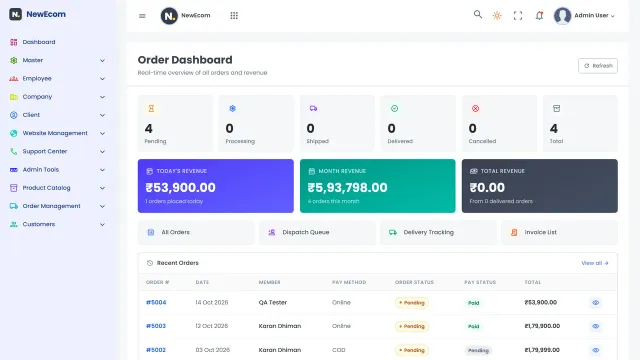
Most of an app's work is invisible to users. The backend stores data, runs business rules, sends notifications and talks to other systems through APIs. Behind almost every business app there is also an admin panel where your team manages users, orders, content, pricing and reports. Owners often forget to budget for it, yet it can be as large as the app itself.
What shapes backend cost
- The number of user roles, for example customer, vendor, delivery partner and admin, each with its own permissions and screens.
- Business rules such as pricing logic, commissions, approvals, refunds and inventory.
- Reports and dashboards your team needs every day.
- Expected scale, security requirements and data protection obligations.
- Hosting and cloud set-up, backups, monitoring and staging environments.
A well-designed API also lets you add a website or a second app later without rebuilding the core, which saves money over the life of the product.
Third-party integrations
Integrations let you reuse proven services instead of building them, but each one still needs development, testing and error handling. Common integrations for Indian apps include:
- Payment gateways for UPI, cards, net banking and wallets. Our guide to choosing a payment gateway for e-commerce explains the options.
- SMS and WhatsApp messaging for OTPs, order updates and reminders.
- Maps, location and route services for delivery and field apps.
- Push notification services, email delivery and analytics.
- Accounting, ERP, GST invoicing or CRM systems your business already uses.
Many of these services also charge their own usage or subscription fees, separate from development. Ask your vendor to list every third-party service in the quote so you know your running costs before you commit.
Testing, launch and ongoing maintenance
Quality assurance covers functional testing, testing on a range of real Android and iOS devices and screen sizes, performance testing and security checks. Launch involves preparing store listings, screenshots and privacy details, and handling Google Play and Apple App Store review. Both stores also have their own developer account fees, which you pay directly.
The cost to create a mobile app does not end at launch. Android and iOS release major updates every year, third-party SDKs change, security patches are needed and users will ask for improvements. Plan for an annual maintenance arrangement that covers bug fixes, OS compatibility updates, server monitoring and small enhancements. Our software maintenance and support service is built for exactly this.
How to get an accurate estimate
The more clearly you describe your app, the more accurate and comparable your quotes will be. Before you approach vendors, prepare the following:
- A one-paragraph summary of the problem the app solves and who it is for.
- The user roles and what each one needs to do.
- A feature list, marked as must-have for launch or later phase.
- Target platforms: Android, iOS, web, or all three.
- Examples of apps you like and why, for design direction.
- Integrations you need, such as payments, SMS, maps or your ERP.
- Your target launch date and any fixed deadlines.
- Who will host and maintain the app after launch.
With this information, a good vendor can break the work into modules and estimate each one. At Sysfo, we review your requirements, suggest an MVP scope if it helps, and give you a fixed, itemised quote so you can see exactly what the cost to create a mobile app covers for your project. You can share your requirements through our get a quote page.
Frequently asked questions
How much does it cost to create a mobile app in India?
It depends on the features, the platforms you target, the design depth, the backend and admin panel, integrations and support. A simple informational app needs far less effort than a marketplace with live tracking and payments. The reliable way to know is to share a feature list with a vendor and ask for a fixed, itemised quote that shows the effort for each module.
Is it cheaper to build one cross-platform app than two native apps?
Usually yes. Frameworks such as Flutter and React Native let one codebase run on both Android and iOS, which reduces development and maintenance effort. Native apps still make sense when the app relies heavily on device hardware, complex graphics or maximum performance. For most business apps, cross-platform gives the best balance of cost, speed and quality.
How long does it take to build a mobile app?
A focused MVP with a handful of core features can often be built in a few months, while a multi-role platform with an admin panel, payments and tracking takes longer. Timelines depend on scope, how quickly feedback and approvals happen, and app store review. Breaking the project into phases with clear milestones keeps the schedule predictable.
What are the ongoing costs after launching an app?
Expect costs for cloud hosting, third-party services such as SMS, maps and payment processing, app store developer accounts, and a maintenance plan for bug fixes, security patches and yearly Android and iOS compatibility updates. New features are usually quoted separately. Ask your vendor to list these running costs before development starts so there are no surprises.
Do I need an admin panel for my app?
Almost every business app needs one. The admin panel is where your team manages users, orders, products, content, pricing, notifications and reports without asking a developer. It is often as large as the app itself, so confirm that it is included in any quote and that it covers the daily tasks your team will actually perform.